Guide
Gross yield, net yield and cash flow
Gross yield is the figure in the advertisement. Net yield is what is left after the costs of holding. Cash flow is what is left after the bank.
Reviewed
Each term is defined in the glossary. All guides.
Rent and capital growth
A let property pays in two ways. The tenant pays rent each year, and the property may be worth more or less on the day you sell.
Yield measures the first. It says nothing about the second, which is capital growth, and we do not forecast it.
Gross yield
Gross yield is a year’s rent as a share of the price, before any cost.
Gross yield = yearly rent ÷ price × 100
The sample report’s flat, a one-bedroom flat in Princess Tower, is entered at AED 1,450,000 with a rent of AED 85,000 a year. That is a gross yield of 5.86%.
Worked on the sample report’s property: a one-bedroom flat of 870 sq ft in Princess Tower, Dubai Marina, entered at AED 1,450,000 with a rent of AED 85,000 a year. The asking price and the rent expected are an example of ours, entered for the sample report. They are not a listing. The registered figures were read on 10 October 2026. The same property, in full.
It is the figure an advertisement quotes, and it is the largest a property will ever show, because nothing has been taken off. It leaves out the service charge, maintenance, management, insurance, empty months and every buying cost.
Use it to sift a long list of listings, then move to net yield.
Net yield
Net yield takes the costs of holding off the rent first: empty months, the service charge, letting and management, maintenance and insurance. What is left is net operating income.
Net yield = net operating income ÷ price × 100
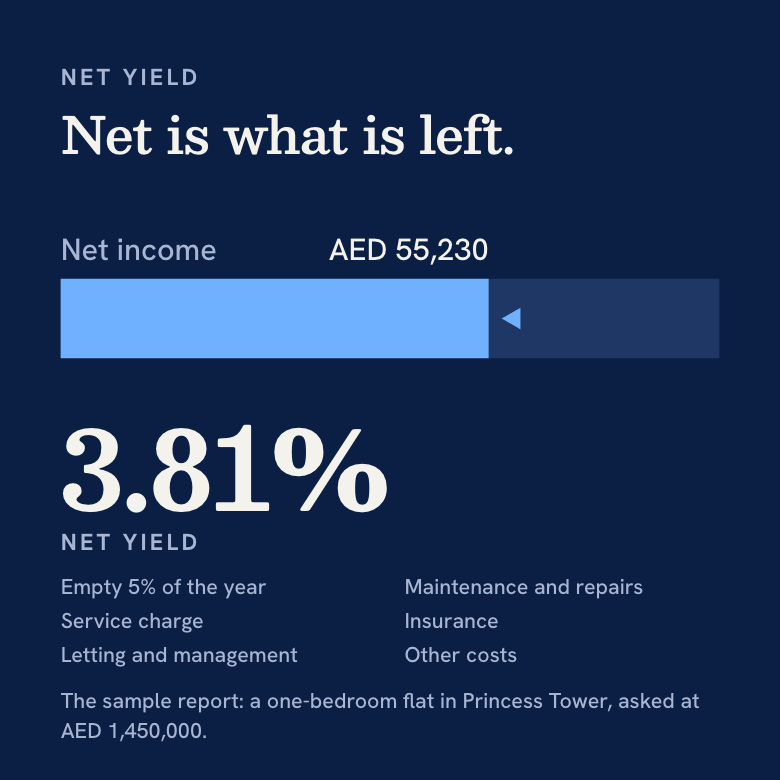
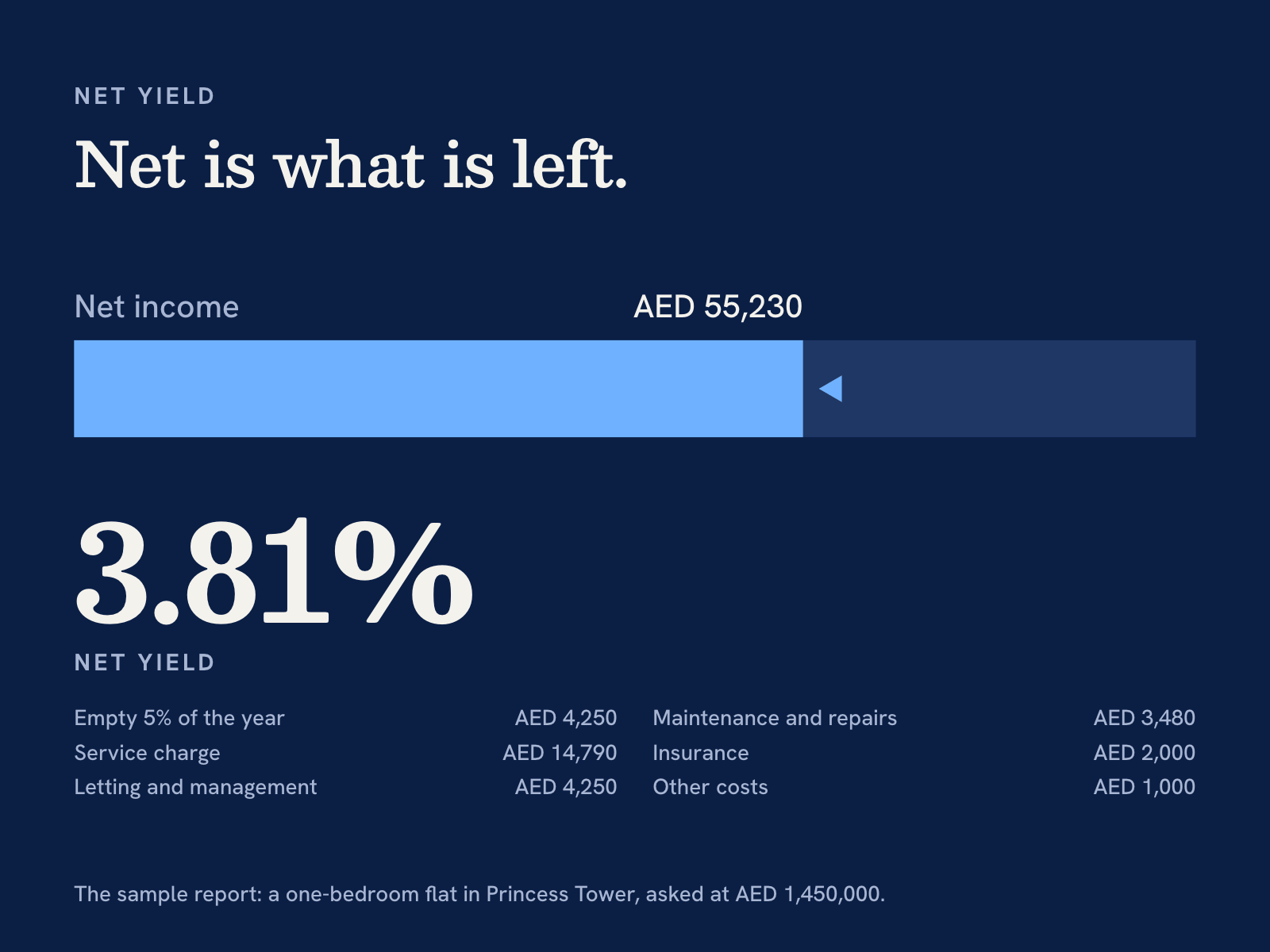
The mortgage is not in it. Net yield is the same for a cash buyer and a borrower, which makes it the fair figure for setting one property against another.
It leaves out the buying costs and any change in what the property is worth.
Cash flow
Cash flow is what is left of the rent after the costs of holding and the mortgage payment. It is the money that reaches your account, or leaves it.
Cash flow = net operating income − mortgage payments
- Net operating income, a year
- AED 55,230
- Mortgage payments, a yearA loan of AED 1,160,000 at 4.25% over 25 years.
- (AED 75,410)
- Cash flow, a year
- (AED 20,180)
- Cash flow, a month
- (AED 1,682)
A figure in brackets is money out. A negative cash flow is a payment you make from your own income every month for as long as you hold the property.
Part of each mortgage payment repays the loan, and that part comes back when you sell. Cash flow counts it as money out all the same, because it has left your account.
Before you accept a negative figure, ask what a month with no tenant looks like. The mortgage and the service charge are still due.
Cash-on-cash return
Cash-on-cash return is a year’s cash flow as a share of the cash you put in: the deposit and every buying cost.
Cash-on-cash return = yearly cash flow ÷ cash put in × 100
On the sample report’s flat the cash put in is AED 408,390 and the year’s cash flow is (AED 20,180). The cash-on-cash return is -4.94%.
It measures your own money after the bank has been paid, so it moves with the deposit and the mortgage rate. It leaves out capital growth and the part of the loan you have repaid.
Break-even occupancy
Break-even occupancy is the share of the year the property must be let for the rent to cover every cost of holding and the mortgage.
Break-even occupancy = (costs of holding + mortgage payments) ÷ a full year’s rent × 100
On the sample report’s flat: Even let every week of the year, the rent does not cover the costs and the mortgage.
The lower the figure, the more empty weeks the purchase can absorb.
The return over a hold
Yield describes one year. A purchase is judged over the years you hold it and on the day you sell.
Total return adds it up: the sale price, less the loan still owed, the selling costs and the cash you put in, with each year’s cash flow added or taken off. Return on investment is that sum as a share of the cash you put in.
Both rest on a sale price nobody knows today. The calculator asks you for a yearly rate of capital growth and works the sum on it. That rate is an assumption. A report works the same sum with no growth and with a fall.
- Prices fall 3% a year
- (AED 324,677)
- Prices stay where they are
- (AED 124,143)
- Prices rise 5% a year
- AED 283,662
The sample report’s flat sold after 5 years: what the buyer is up or down in all on the AED 408,390 put in. A figure in brackets is a loss. These are stated paths, not forecasts.
Which figure to use
- Gross yield, to sift a list of listings.
- Net yield, to set one property against another.
- Cash flow, to see whether you can carry the purchase month by month.
- Cash-on-cash return, to judge a deposit and a mortgage.
- The return over the hold, with a stress test, before you commit.
The calculator works net yield and monthly cash flow at once, with the cash you need to complete. The stress test is part of a report.